How to build a dental school list around your GPA and DAT
A school-by-school way to decide where your applications go
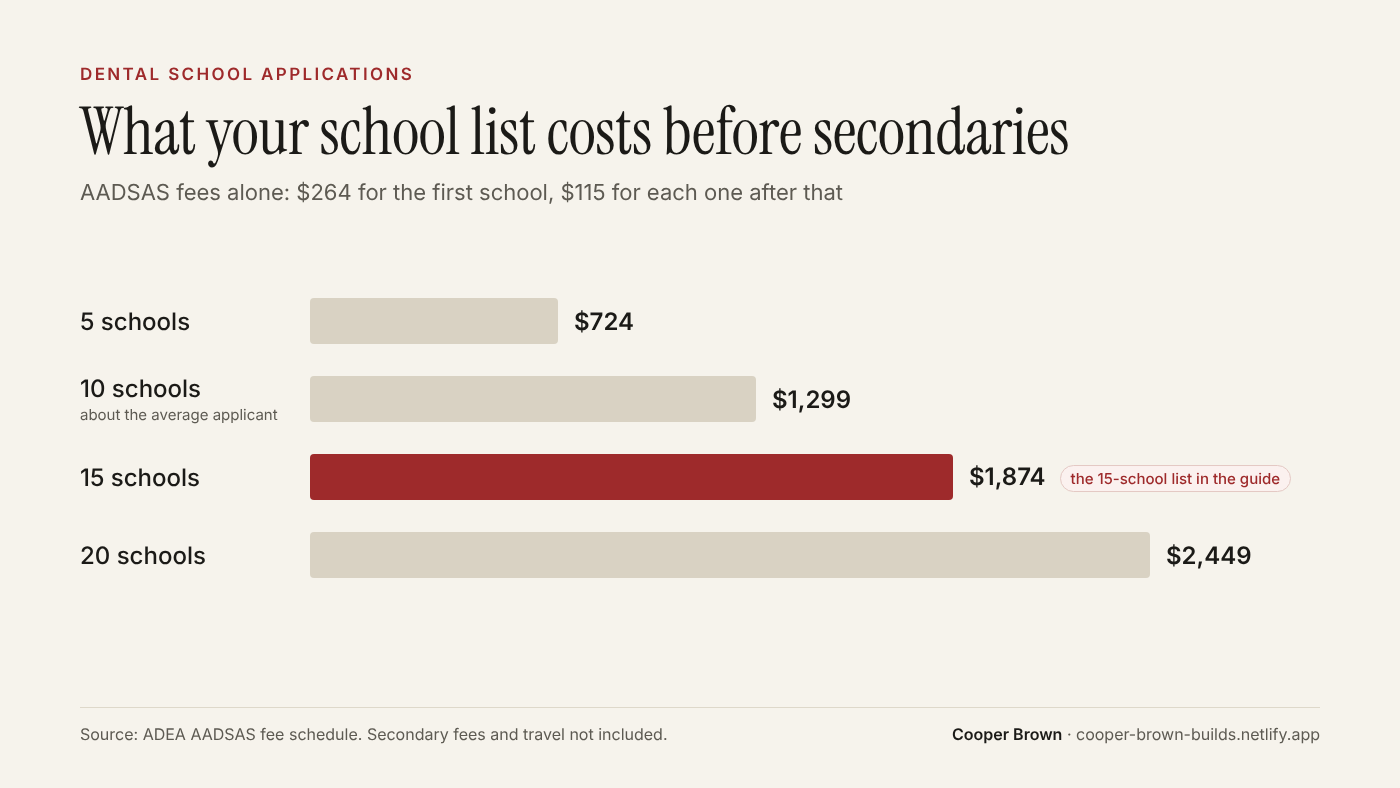
Dental school applicants applied to about 9.8 schools on average, according to ADEA. AADSAS charges $264 for the first school and $115 for each one after that, and many schools add their own secondary fee, so a 15-school list costs more than $1,800 before secondaries or travel.
I'm a pre-dental student at USC. I wrote this guide with help from an AI writing assistant, and the figures in it come from ADEA and the ADA.
Start with where you live
Many public dental schools admit mostly residents of their own state. If your state has a public dental school, it usually belongs on your list, because residency can matter more than a few tenths of a GPA point. Some states also have agreements that give residents better odds at schools in nearby states, so check yours.
Compare your numbers with each school
National averages tell you little on their own. For a recent entering class, accepted students averaged about a 3.55 to 3.6 overall GPA and a DAT Academic Average around 19 to 21 on the old 30-point scale. Individual schools sit well above and below that.
Pull each school's average GPA, science GPA and DAT for its most recent class. Sort the list into schools where you're at or above both averages, schools where you're close, and schools where you're below. Most of your applications should go to the first two groups.
A strong DAT can offset a GPA below a school's average, and the reverse works too. An upward GPA trend counts as well, so make it visible if your first year was rough.
Read the requirements before you pay
Schools differ on shadowing hours, prerequisite courses, letters of recommendation and how they treat retakes. A school that requires a course you haven't taken, or more shadowing than you'll have by the deadline, is a wasted fee this cycle.
Submit early
Many dental schools review applications on a rolling basis. A complete application in early summer competes for more open interview slots than the same application in the fall.
Where AdmitPath fits
I built AdmitPath to handle the comparison step. You enter your GPA, your DAT or MCAT and your state, and it rates each of 319 dental, MD and DO programs as a Strong, Competitive or Weak academic fit. It measures academics and residency and nothing else. Every school number carries a label showing whether it was verified from the school's own class profile, estimated, or not yet published, and most are still estimates.
Scoring, five saved schools and the hour log are free. A one-time Cycle Pass covers the 2026 to 27 cycle with unlimited schools, a nine-status tracker and secondary fee tracking. It costs $39 for the first 100 founding buyers and $79 after launch.
You can try it at getadmitpath.pages.dev. If you spot a wrong verified number, report it and your Cycle Pass is free.
Application figures from ADEA and the ADA Health Policy Institute. Confirm each school's numbers on its own admissions page before you apply.